
A digital marketing retainer is defined as a fixed recurring fee paid to a marketing agency for continuous, ongoing services that replace fragmented one-off projects. Monthly retainers typically range from $2,000 to $10,000 for local businesses, with enterprise-level arrangements exceeding $31,000 per month. Under this model, your agency handles strategy, execution, optimisation, and reporting on a rolling basis, rather than stopping work the moment a single campaign wraps up. For business owners and marketing professionals who want sustained online growth, understanding this structure is the foundation of every productive agency relationship.
What is a digital marketing retainer and how does it work?
A marketing retainer is a formal agreement where a business pays a set monthly fee in exchange for a defined scope of ongoing marketing services. Think of it less like hiring a contractor for a single renovation and more like retaining a trusted adviser who learns your business deeply over time. The agency commits dedicated resources to your account each month, and you gain continuity of strategy rather than starting fresh with every new brief.
The scope covered under a retainer typically spans strategy development, channel execution, creative production, performance reporting, and account management. Services bundled under a retainer vary from single-channel execution, such as Google Ads management alone, through to full multi-channel marketing teams covering SEO, paid media, content, social, and email. The pricing reflects that breadth. A business investing $2,500 per month might receive focused PPC management and monthly reporting, while one investing $8,000 per month might receive a fully integrated programme across four or five channels.

What makes the retainer model distinct is the absence of a fixed end date. Work continues, compounds, and improves as the agency accumulates knowledge about your audience, your competitors, and what genuinely drives results for your business.
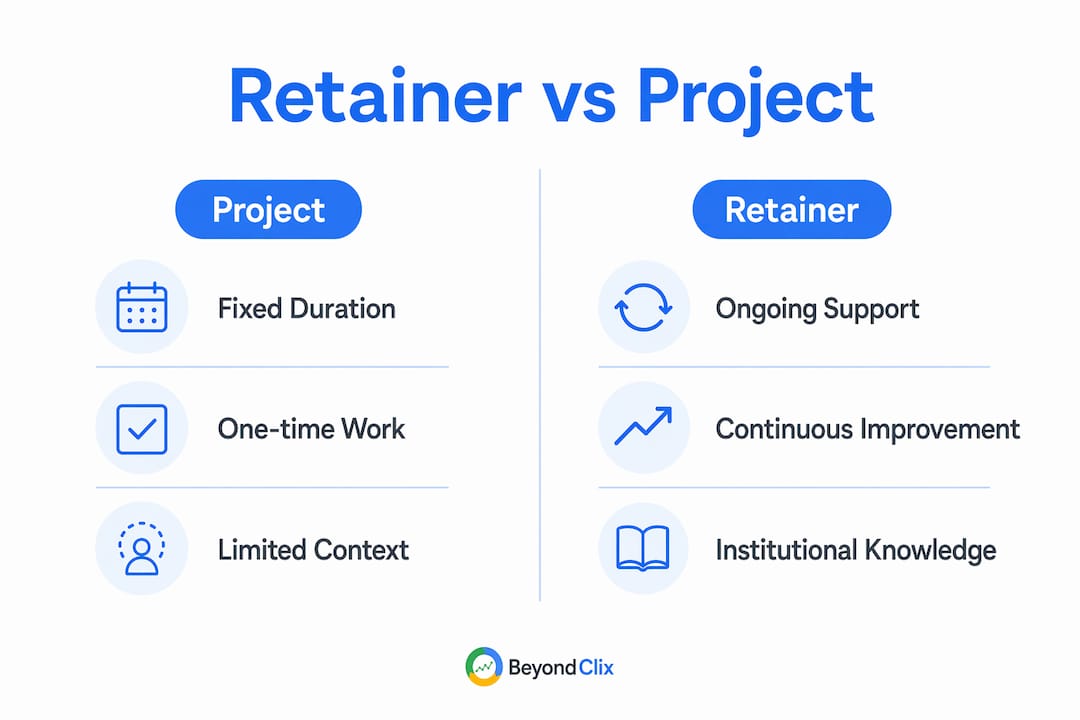
How does a retainer differ from project-based marketing work?
Project fees charge for a defined piece of work with a fixed start and end point. A website redesign, a product launch campaign, or a one-off SEO audit are all project-based engagements. Once the deliverable is complete, the relationship ends and the agency moves on.
The practical consequence of that model is context loss. Every time you engage a new agency or restart a project, you spend the first weeks re-educating them on your brand, your audience, and your previous results. Retainers eliminate that cost. Ongoing marketing relationships yield better performance through accumulated audience understanding, because the agency carries forward every insight from month to month.
The table below summarises the core differences between the two models.
| Factor | Project-based | Retainer |
|---|---|---|
| Duration | Fixed start and end date | Ongoing, no fixed end |
| Payment | One-off or milestone-based fee | Fixed monthly fee |
| Scope | Defined deliverable | Continuous services |
| Context retention | Resets with each engagement | Builds over time |
| Budget predictability | Variable across projects | Consistent monthly spend |
For businesses running continuous digital marketing activity, such as paid search, SEO, or social media, the retainer model almost always delivers better value per dollar than stringing together a series of projects.
What services and deliverables typically come with a retainer?
An effective retainer integrates diverse marketing functions under one monthly fee, though the exact mix depends on your business goals and budget. The most common services included are:
- Paid media management: Google Ads, Microsoft Advertising, and paid social campaigns, including bid management, audience targeting, and creative testing.
- Search engine optimisation: Technical audits, on-page optimisation, link building, and content strategy aligned to organic growth targets.
- Content creation: Blog articles, landing pages, ad copy, and email sequences produced to a defined monthly output.
- Social media management: Organic posting, community engagement, and platform-specific strategy across channels like LinkedIn, Instagram, or Meta.
- Email marketing: Campaign planning, copywriting, list segmentation, and performance analysis.
- Reporting and analytics: Monthly performance reports covering agreed KPIs, with interpretation and recommended next steps.
The structure of how these services are delivered matters as much as the list itself. Retainers are generally structured in one of two ways: hours-based or deliverable-based. An hours-based retainer allocates a set number of agency hours per month to your account. A deliverable-based retainer specifies exact outputs, such as eight creative pieces, two blog posts, and one performance report per month.
Deliverable-based retainers align agency incentives with client goals and protect clients from paying for low-value administrative tasks. When an agency commits to producing eight creative pieces per month, they are motivated to work efficiently and focus on impact rather than filling hours. This model also makes it far easier for you to evaluate whether you are receiving fair value.
Pro Tip: Before signing any retainer agreement, ask the agency to list every deliverable by name and frequency. If they can only describe their work in hours, push for a deliverable-based structure instead. It protects your budget and sharpens their focus.
What are the main benefits of a digital marketing retainer?
The most compelling case for a retainer is compounding performance. Agencies that retain clients long term accumulate unique insights about customer behaviour, seasonal campaign performance, and messaging that improve ROI in a way project-based engagements simply cannot match. A Google Ads campaign managed for 18 months by the same team will almost always outperform one managed by a new agency every six months, because the data history, audience signals, and creative learnings stay intact.
“Effective marketing needs ongoing commitment. Agencies warn against expecting immediate results, and most retainers require 3 to 6 month minimums to allow time for genuine optimisation.” — Digital marketing retainer services guide
Beyond compounding performance, the practical advantages of a retainer include:
- Predictable budgeting: A fixed monthly fee makes financial planning straightforward. You know your marketing spend 12 months in advance.
- Faster execution: An agency already familiar with your brand, tone, and approvals process moves faster than one starting from scratch.
- Proactive strategy: Rather than waiting for you to brief a new project, a retained agency monitors performance and recommends adjustments before problems escalate.
- Unified reporting: All channels are reported together, giving you a single view of marketing performance rather than disconnected project summaries.
- Stronger agency investment: When an agency knows they are working with you long term, they invest more deeply in understanding your market and your customers.
For businesses outsourcing digital marketing for the first time, the retainer model also removes the operational burden of managing multiple specialist contractors across different channels. One relationship, one invoice, one point of accountability.
What legal and contractual elements should you check before signing?
A digital marketing contract is only as strong as the clarity of its terms. Before committing to any retainer agreement, work through the following checklist with your legal adviser or internal team.
-
Intellectual property ownership. Contracts should clarify IP rights transfer on payment, meaning all creative assets, copy, and campaign data produced under the retainer become your property once fees are paid. Never assume this is automatic. Agencies that retain IP ownership of your ad creative or website content can hold your business to ransom if the relationship ends.
-
Commitment period and cancellation terms. Most retainers run on a month-to-month basis with 30 days’ notice but require a 3 to 6 month minimum to allow time for optimisation. Understand the minimum term before signing, and confirm what happens to work in progress if you cancel early.
-
Scope change procedures. Marketing needs evolve. Your contract should define how scope changes are requested, approved, and priced. Without this, you risk either paying for work you did not ask for or being told that a reasonable request falls outside the retainer.
-
Named contacts and response times. Specify who manages your account by name or role, and set agreed response times for communications. Vague contracts that promise “a dedicated team” without naming anyone create accountability gaps.
-
Performance benchmarks. Define the KPIs the agency is responsible for, such as cost per lead, organic traffic growth, or return on ad spend. Benchmarks give both parties a shared definition of success and make performance reviews far more productive.
Pro Tip: Ask for a sample monthly report before signing. If the agency cannot show you what accountability looks like in practice, that tells you everything you need to know about how they operate.
Agency professionals recommend businesses define contract terms clearly to prevent disputes, with particular focus on scope, IP ownership, and performance benchmarks. A well-drafted retainer agreement protects both parties and sets the tone for a genuinely collaborative relationship.
Key takeaways
A digital marketing retainer delivers compounding performance, predictable costs, and institutional knowledge that project-based work cannot replicate, making it the most effective model for businesses committed to sustained online growth.
| Point | Details |
|---|---|
| Definition and pricing | A retainer is a fixed monthly fee for ongoing services, typically $2,000 to $10,000 for local businesses. |
| Deliverable-based structure | Specify exact monthly outputs rather than hours to protect your budget and align agency incentives. |
| Compounding performance | Long-term agency relationships accumulate audience insights that improve ROI over time. |
| Contract essentials | Confirm IP ownership, cancellation terms, named contacts, and performance benchmarks before signing. |
| Minimum commitment | Expect a 3 to 6 month minimum term, as effective optimisation requires sustained, ongoing effort. |
Why I believe deliverable-based retainers change everything
Working with clients across industries, I have seen the same pattern repeat itself. A business signs a retainer, receives a monthly hours report showing 40 hours of work, and has no idea whether those hours produced anything meaningful. Hours are a measure of effort, not impact. They tell you the agency was busy. They do not tell you whether your business grew.
The shift to deliverable-based retainers changes that dynamic entirely. When an agency commits to producing a specific number of assets, campaigns, or reports each month, the conversation moves from “how much time did you spend?” to “what did we achieve?” That is a far healthier basis for a long-term partnership.
I also believe most businesses underestimate how much value comes from an agency that genuinely knows their market. The first three months of any retainer are largely about learning. By month six, a good agency starts to anticipate your audience’s behaviour rather than just react to it. By month twelve, they are making recommendations you had not thought to ask for. That accumulated intelligence is the real return on a retainer investment, and it is something no project engagement can replicate.
The one oversight I see most often is businesses treating their retainer agency as a vendor rather than a partner. If you only engage with your agency during monthly reporting calls, you will get reporting-level results. The businesses that get the most from their retainers are the ones that share context freely, give honest feedback, and treat the relationship as genuinely collaborative. Your agency’s ability to improve Google Ads ROI or grow organic traffic depends directly on how well they understand your business. Give them that understanding, and the results follow.
— Samar
How Beyondclix can support your retainer strategy
Beyondclix works with startups and established businesses across Australia to deliver retainer-based digital marketing that is built around measurable outcomes, not billable hours. Our retainer services cover Google Ads management, SEO, content, and performance reporting, all structured around clear monthly deliverables so you always know exactly what you are receiving and why. Clients regularly report returns on ad investment exceeding 10:1, a result that comes from sustained optimisation rather than one-off campaigns. If you are ready to move from fragmented projects to a continuous marketing strategy that compounds over time, explore our full-service marketing solutions or visit our Google Ads and PPC services to see how we structure retainers for performance.
FAQ
What is a digital marketing retainer in simple terms?
A digital marketing retainer is a fixed monthly fee paid to an agency for continuous marketing services, including strategy, execution, and reporting. It replaces one-off projects with an ongoing partnership focused on sustained growth.
How much does a digital marketing retainer cost?
Monthly retainers typically range from $2,000 to $10,000 for local businesses, with enterprise arrangements exceeding $31,000 per month depending on the scope and number of channels managed.
What is the difference between a retainer and a project fee?
A project fee covers a defined piece of work with a fixed start and end date, while a retainer provides continuous marketing support without a fixed end date. Retainers preserve campaign context and institutional knowledge that project-based work resets with every new engagement.
How long should a digital marketing retainer run?
Most retainers require a minimum commitment of 3 to 6 months to allow sufficient time for optimisation and measurable results. Month-to-month arrangements with 30 days’ notice are common after the minimum term is satisfied.
What should a retainer agreement include?
A retainer agreement should specify monthly deliverables, IP ownership terms, cancellation conditions, named account contacts, response time commitments, and agreed performance benchmarks to protect both parties and set clear expectations from the start.
