
A digital marketing funnel is defined as a structured model that maps the complete customer journey from first brand awareness through to purchase, retention, and advocacy across digital channels. Unlike a traditional sales pipeline, which focuses narrowly on closing transactions, the digital marketing funnel encompasses the entire customer lifecycle. It incorporates CRM systems, multi-channel automation, and measurable outcomes at every stage. For businesses and marketers, understanding this framework is the foundation of any customer acquisition and conversion strategy worth building.
What is the digital marketing funnel and why does it matter?
The digital marketing funnel, also referred to in industry practice as the “purchase funnel” or “conversion funnel,” is a strategic framework that organises every marketing touchpoint a prospect encounters before, during, and after a purchase. It gives marketers a shared language for diagnosing performance and allocating resources with precision. Without it, campaigns become disconnected activities rather than a coordinated system.
The funnel’s greatest value lies in its role as a diagnostic tool to identify where leads go dark, allowing messaging to be adapted rather than blindly increasing traffic. This distinction matters enormously. Most underperforming campaigns suffer not from insufficient reach but from unaddressed friction at specific stages. A well-structured funnel makes those friction points visible and measurable.

A well-optimised funnel functions as an operating system for revenue, enabling forecasting and evidence-based resource allocation by tracking conversion rates and velocity at each stage. For a startup spending $10,000 per month on Google Ads, that visibility is the difference between scaling confidently and burning budget without direction.
What are the primary stages of a digital marketing funnel?
The industry-standard funnel in 2026 includes five key stages: Awareness, Interest, Consideration, Conversion, and Expansion. High-performing organisations have widely adopted this five-stage model because it accounts for the full customer lifecycle, not just the transaction. Each stage has distinct goals, content types, and success metrics.
Here is how each stage functions in practice:
- Awareness (Top of Funnel): The prospect discovers your brand through SEO content, Google Ads, social media, or display advertising. The goal is reach and recognition. Key metrics include impressions, organic traffic, and click-through rates.
- Interest (Upper-Mid Funnel): The prospect engages with your content, subscribing to a newsletter, watching a product video, or reading a blog series. The goal is engagement. Metrics include time on page, email open rates, and social shares.
- Consideration (Mid Funnel): The prospect actively evaluates your offering against alternatives. Webinars, case studies, comparison pages, and retargeting ads are the primary tools here. Metrics include lead magnet downloads, demo requests, and return visit rates.
- Conversion (Bottom of Funnel): The prospect becomes a customer. Friction reduction is the priority: clear calls to action, simplified checkout, and targeted PPC campaigns. Metrics include cost per acquisition, conversion rate, and revenue per lead.
- Expansion and Advocacy (Post-Purchase): The customer is retained, upsold, and converted into a brand advocate through loyalty programmes, personalised email sequences, and community engagement. Metrics include customer lifetime value, net promoter score, and referral rates.
The table below contrasts the classic three-stage funnel with the modern five-stage model:
| Classic funnel stage | Modern equivalent | Primary focus |
|---|---|---|
| Top of Funnel (TOFU) | Awareness + Interest | Brand discovery and initial engagement |
| Middle of Funnel (MOFU) | Consideration | Evaluation and lead nurturing |
| Bottom of Funnel (BOFU) | Conversion | Purchase and friction reduction |
| Not included | Expansion and Advocacy | Retention, upsell, and referral |
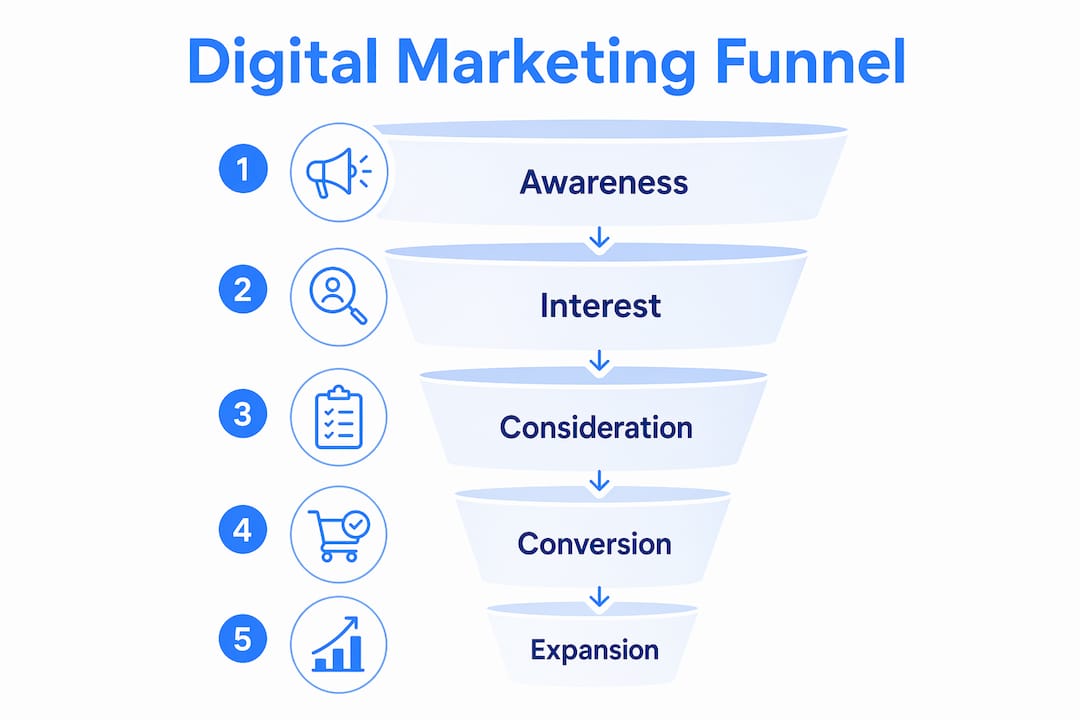
The addition of the Expansion stage is not cosmetic. Neglecting post-sale nurturing leads to wasted acquisition spend and high churn rates, which erodes the return on every dollar invested in the upper funnel.
How does the digital marketing funnel differ from a traditional sales funnel?
The traditional sales funnel is a seller-centric process designed to move a qualified prospect toward a signed contract. The digital marketing funnel is a buyer-centric ecosystem that accounts for every interaction a person has with a brand across social media, email, paid search, and organic content. This is not a subtle distinction. It changes how teams are structured, how budgets are allocated, and how success is measured.
Digital marketing funnels in 2026 encompass the entire customer lifecycle including post-purchase retention and advocacy, whereas narrower sales funnels focus on transactions. A SaaS company using only a sales pipeline might track opportunities from demo to close but miss the fact that 40% of churned customers never received a single onboarding email. The digital funnel catches that gap.
Four practical differences that define the distinction:
- Scope: The digital funnel begins before a prospect knows your brand exists and continues long after they purchase. The sales funnel begins at lead qualification.
- Channel breadth: Digital funnels operate across SEO, paid media, social, email, and SMS simultaneously. Sales funnels are typically managed within a CRM as a linear pipeline.
- Data source: Digital funnels draw on behavioural analytics, attribution models, and engagement signals. Sales funnels rely primarily on rep-entered CRM data.
- Ownership: Digital funnels require marketing and sales alignment. Sales funnels are owned by the sales team.
Modern marketing funnels are no longer linear but act as data-informed ecosystems using automation and CRM workflows to deliver personalised nurture sequences. Automation is what makes this scale. Without it, personalising communication across thousands of leads at different funnel stages is operationally impossible.
Pro Tip: Set up CRM lifecycle stages that mirror your funnel stages exactly. When a lead’s behaviour triggers a stage change, an automated workflow should fire immediately rather than waiting for a sales rep to manually update a record.
What practical strategies optimise each funnel stage?
Funnel optimisation is not a single campaign decision. It is a set of stage-specific choices about content format, channel, and timing that compound over time. Successful funnels use multi-channel full-funnel campaigns combining SEO, social, email, and PPC, enhanced with CRM and automation to personalise content and messaging. The result is improved lead nurturing and higher conversion rates across the board.
Stage-specific tactics that produce measurable results:
- Awareness: Publish SEO-optimised blog content targeting informational keywords. Run Google Display and YouTube pre-roll ads to build brand recognition. Use social media to distribute content and generate first-touch engagement.
- Interest: Deploy lead magnets such as checklists, templates, or short video courses. Use Klaviyo or a comparable email platform to trigger a welcome sequence the moment someone subscribes.
- Consideration: Run retargeting campaigns on Google and Meta to re-engage visitors who did not convert. Offer webinars, detailed case studies, and free consultations. Use A/B testing to refine landing page messaging and reduce drop-off.
- Conversion: Minimise form fields. Use urgency-based copy where genuine. Align ad copy with landing page headlines to reduce cognitive dissonance. Implement Google Ads Smart Bidding to target high-intent searchers at the moment of decision.
- Expansion: Build post-purchase email sequences in Klaviyo or HubSpot that deliver onboarding value, cross-sell relevant products, and request reviews at the right moment.
Personalisation is key to funnel success, making customer journeys feel relevant and increasing engagement and loyalty. Tailored content, offers, and interactions reduce friction and build long-term customer relationships. Generic broadcast emails sent to an entire list regardless of funnel stage are one of the most common and costly mistakes marketers make.
Pro Tip: Use lead scoring in your CRM to assign point values to specific behaviours: visiting a pricing page might score 10 points, downloading a case study 15 points, and attending a webinar 25 points. When a lead crosses a threshold, trigger a sales follow-up or a high-intent email sequence automatically.
What are common challenges when managing a digital marketing funnel?
The most damaging funnel mistakes are not technical failures. They are strategic misalignments that compound quietly over months before showing up as poor ROI. Misalignment between internal sales and marketing goals and buyer needs at each funnel stage is a common cause of underperformance. Top-of-funnel activity should generate interest, while bottom-of-funnel activity must reduce friction to convert intent into revenue.
The most frequent pitfalls include:
- Over-investing in awareness without nurturing infrastructure: Driving traffic to a site with no email capture, no retargeting pixel, and no follow-up sequence is the equivalent of filling a bucket with a hole in it.
- Ignoring the Expansion phase: The Expansion and Advocacy phase is critical for sustainable growth and must be integrated from the start, not treated as an afterthought. Businesses that skip post-purchase engagement lose the compounding value of referrals and repeat purchases.
- Disjointed cross-channel messaging: A prospect who sees a brand awareness ad on LinkedIn, then receives a hard-sell email the next day, experiences a jarring disconnect. Consistent messaging across every touchpoint is non-negotiable.
- Treating the funnel as static: Modern consumers interact non-linearly across channels and devices. A prospect might discover a brand via a podcast mention, research it on mobile, and convert on desktop three weeks later. Rigid, stage-by-stage assumptions miss this reality entirely.
The funnel’s true value is in identifying bottlenecks and drop-off points, allowing data-driven adjustments rather than increasing traffic indiscriminately.
Continuous measurement and testing are not optional refinements. They are the mechanism by which a funnel improves over time rather than decaying as market conditions shift.
How can businesses integrate tools and technology for full-funnel success?
Technology does not replace funnel strategy, but it makes strategy executable at scale. CRM platforms like HubSpot and Salesforce track every lead interaction, automate stage transitions, and surface the data needed to make informed decisions. Email and SMS platforms like Klaviyo handle multi-channel automation within the funnel, delivering personalised sequences triggered by real-time behaviour rather than calendar schedules.
The table below outlines the primary tools and their funnel functions:
| Tool category | Example platforms | Funnel function |
|---|---|---|
| CRM and lead management | HubSpot, Salesforce | Track interactions, automate stage transitions, score leads |
| Email and SMS automation | Klaviyo, ActiveCampaign | Deliver personalised nurture sequences across channels |
| Paid media | Google Ads, Meta Ads | Drive awareness and retarget high-intent prospects |
| Analytics and attribution | Google Analytics 4, Semrush | Monitor drop-off points and measure multi-touch attribution |
| Landing page and CRO | Unbounce, Leadpages | Optimise conversion at the bottom of the funnel |
The Google Ads full-funnel opportunity is particularly significant because Google’s campaign types now span every funnel stage. Demand Gen campaigns build awareness, Performance Max captures mid-funnel intent, and Search campaigns with Smart Bidding close high-intent prospects at the conversion stage. Running these in a coordinated structure, rather than as isolated campaigns, produces materially better results. Analytics dashboards that consolidate data from paid, organic, and email channels give marketers a single view of funnel performance, making it far easier to identify where the next optimisation effort should be directed.
Key takeaways
A digital marketing funnel works because it aligns specific strategies, content, and tools to each stage of the customer journey, turning scattered marketing activity into a measurable, optimisable system.
| Point | Details |
|---|---|
| Five-stage model is the standard | The Awareness, Interest, Consideration, Conversion, and Expansion model covers the full customer lifecycle. |
| Funnel as diagnostic tool | Drop-offs signal messaging misalignment or friction, not just poor content quality. |
| Automation is non-negotiable | CRM workflows and platforms like Klaviyo make personalised nurturing scalable across thousands of leads. |
| Expansion phase drives ROI | Post-purchase engagement compounds acquisition investment through retention, upsell, and referrals. |
| Non-linear journeys require fluid design | Static funnel paths fail modern consumers who move across channels and devices unpredictably. |
Why I think most businesses are using their funnel backwards
After working with businesses across a wide range of industries, the pattern I see most consistently is this: organisations invest heavily in the top of the funnel and treat everything below Awareness as secondary. They run Google Ads, publish content, and generate traffic. Then they wonder why conversion rates are low and customer lifetime value is disappointing.
The uncomfortable truth is that most funnels are built for acquisition and neglect retention entirely. The Expansion phase is where the real return on investment compounds. A customer who buys twice and refers one friend is worth three to four times more than a single-purchase customer, yet the post-purchase experience often receives a fraction of the budget and attention.
What I have also observed is that the businesses achieving the strongest results are not necessarily running the most sophisticated campaigns. They are the ones who have taken the time to map their actual customer journey, identify the two or three stages where leads consistently drop off, and fix those specific points before adding more traffic. More traffic into a broken funnel is just more waste.
The funnel is not a marketing concept. It is a business operating model. Treat it as one, and the data will tell you exactly where to focus next.
— Samar
How Beyondclix helps you build a funnel that converts
Beyondclix specialises in building and optimising full-funnel digital marketing strategies that connect every stage of the customer journey to measurable outcomes. From Google and Bing Ads that capture high-intent prospects at the conversion stage, to full-funnel campaign architecture that coordinates awareness, consideration, and retention in a single system, the team brings both strategic depth and hands-on execution.
Clients working with Beyondclix regularly report returns on ad investment exceeding 10:1, driven by a data-first approach that prioritises funnel diagnostics over guesswork. If you are ready to move beyond disconnected campaigns and build a funnel that actually works, explore Beyondclix’s digital marketing solutions and see what a properly integrated strategy looks like in practice.
FAQ
What is a digital marketing funnel in simple terms?
A digital marketing funnel is a model that maps the stages a potential customer moves through from first discovering a brand to making a purchase and becoming a loyal advocate. It gives marketers a framework for aligning the right content and channels to each stage of the customer journey.
How many stages does a modern digital marketing funnel have?
The industry-standard model in 2026 includes five stages: Awareness, Interest, Consideration, Conversion, and Expansion. The Expansion stage, covering post-purchase retention and advocacy, is what distinguishes the modern funnel from older three-stage models.
What is the difference between a sales funnel and a digital marketing funnel?
A sales funnel is a seller-centric process focused on moving qualified leads to a closed deal, typically managed within a CRM. A digital marketing funnel is broader, covering the entire customer lifecycle across multiple channels including SEO, paid media, email, and social, with a strong emphasis on post-purchase retention.
Why do leads drop off in the middle of the funnel?
Mid-funnel drop-off most commonly results from misaligned messaging, insufficient nurturing sequences, or a lack of personalisation at the Consideration stage. Using lead scoring and CRM automation to deliver relevant content based on a prospect’s specific behaviour significantly reduces this drop-off.
What tools are needed to run a digital marketing funnel effectively?
A functional funnel typically requires a CRM platform such as HubSpot or Salesforce, an email and SMS automation tool such as Klaviyo, a paid media platform such as Google Ads, and an analytics solution such as Google Analytics 4 to monitor performance and identify bottlenecks across every stage.
Recommended
- The Google Ads Full-Funnel Opportunity – BeyondClix, The Growth Agency
- Unlocking the Power of Dynamic Search Ads: How This Tool Can Revolutionize Your Marketing Strategy – BeyondClix, The Growth Agency
- How to Boost Lead Generation with Google Ads: A Comprehensive Guide – BeyondClix, The Growth Agency
- BeyondClix Blogs | Insights on Marketing & Digital Growth
