
Cross-channel campaign management is the coordinated orchestration of marketing messages, timing, audience logic, and budget across multiple channels using a shared decisioning engine and unified data. It is the operational capability that separates marketers who grow revenue from those who simply grow channel count. Where most businesses run email, paid search, SMS, and social as separate programmes, cross-channel management treats them as one interconnected system. Platforms like Braze, Salesforce Marketing Cloud, and Adobe Journey Optimizer exist specifically to enable this kind of orchestration, integrating email, SMS, push notifications, in-app messaging, and paid media into a single coordinated flow.
What is the role of cross-channel campaign management?
The role of cross-channel campaign management is to replace fragmented, channel-by-channel execution with a unified system that coordinates every customer touchpoint. Rather than each channel team making independent decisions about who to message, when, and how often, a single decisioning engine informed by customer engagement history and channel preferences governs all outbound communication. This is not a minor operational upgrade. It fundamentally changes how campaigns are planned, executed, and measured.
The integrated marketing campaign role here is about coherence. A customer who clicks a Google Ad, receives a follow-up email, and then sees a retargeting ad on Meta should experience a logical, progressive conversation, not three disconnected sales pitches. Without shared data and orchestration, that coherence is impossible to achieve at scale.
Cross-channel management also governs budget allocation across channels in real time, shifting spend toward the channels and sequences that are actually converting. This is where the strategic advantage compounds: you are not just coordinating messages, you are continuously learning which combinations of channels and timing produce the best outcomes.

How does cross-channel differ from multichannel and omnichannel?
These three terms are used interchangeably in most marketing conversations, and that confusion costs organisations real money. Each describes a genuinely different operational model.
| Approach | Channel coordination | Data sharing | Customer experience |
|---|---|---|---|
| Multichannel | Independent per channel | Siloed | Presence on multiple platforms |
| Omnichannel | Unified including offline | Shared across all touchpoints | Seamless, consistent experience |
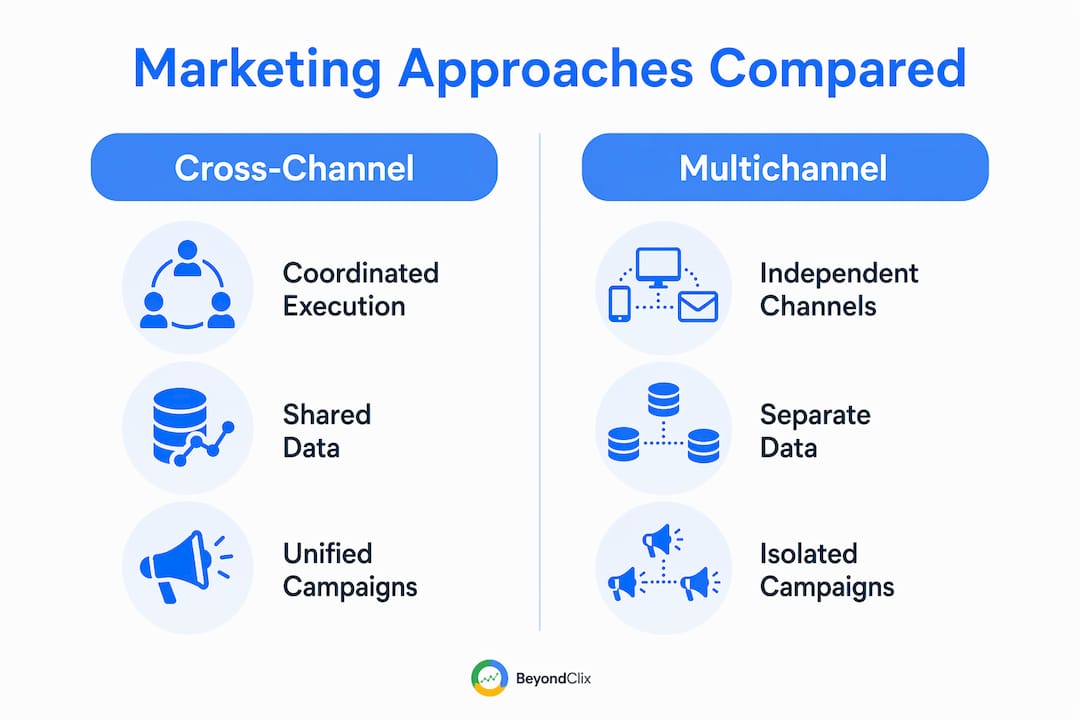
| Cross-channel campaign management | Coordinated campaign execution | Shared decisioning and audience logic | Coherent, sequenced messaging |
Multichannel marketing means your brand is present on email, social, search, and SMS. Each channel is managed independently, often by different teams with different tools and different KPIs. The customer receives messages that may contradict or repeat each other.
Omnichannel marketing extends coordination to include offline touchpoints like in-store, call centres, and physical mail. It is the broadest model and the most resource-intensive to implement correctly. The focus is on seamless customer experience across every interaction, digital or physical.
Cross-channel campaign management sits between these two. It focuses specifically on coordinating campaign execution and optimisation across digital channels using unified planning and orchestration. The distinction matters operationally because cross-channel management is achievable for most mid-sized marketing teams today, while true omnichannel requires enterprise-level infrastructure and organisational alignment that takes years to build.
What technology enables effective cross-channel campaign management?
The technology stack for cross-channel management has four core components, and understanding each one helps you evaluate platforms and identify gaps in your current setup.
- Centralised decisioning engine. This is the brain of the system. It uses customer engagement history, channel preference data, and campaign rules to determine which message to send, on which channel, and at what time. Without this layer, you are back to channel-by-channel guesswork.
- Identity resolution and shared audience logic. A customer who opens your email, clicks your paid ad, and visits your website is one person. Without identity resolution, they appear as three separate users across three platforms. Shared audience logic prevents redundant offers and ensures suppression rules apply across all channels simultaneously.
- Cross-channel frequency capping. Uncoordinated messaging leads to unsubscribes and app deletions. Global frequency caps enforced at the decisioning layer limit the total number of messages a customer receives across all channels within a defined timeframe, regardless of which channel triggers the send.
- Unified attribution and measurement. Accurate attribution requires linking impressions and conversions to a single resolved event stream to prevent double counting across platforms. This produces one source of truth for measuring campaign effectiveness and guides smarter budget decisions.
Real-time, event-driven orchestration adds another dimension. Rather than sending pre-scheduled batch campaigns, streaming data enables personalised messages that match a customer’s exact journey stage and channel preference, increasing open rates by 25% and click-through rates by 17%. That kind of lift is not achievable through batch-and-blast execution.
Pro Tip: Before evaluating orchestration platforms, audit your current identity resolution capability. If you cannot reliably match a customer across email, paid media, and your CRM, no orchestration platform will deliver its full potential.
What are the measurable benefits of cross-channel campaigns?
The business case for coordinated campaign management is well documented. Enterprises with mature cross-channel capabilities report 25 to 35% improved campaign ROI, 40% lower customer acquisition costs, and 30% higher customer lifetime value. These are not marginal improvements. They represent a structural advantage over competitors running fragmented channel programmes.
The compounding effect is what most marketers underestimate. Consistent, sequenced messaging across channels reinforces brand recall and builds trust progressively. A customer who receives a relevant email, sees a coordinated social ad, and then receives a timely SMS reminder is far more likely to convert than one who encounters your brand on a single channel. Cross-channel measurement also enables brands to meet customers across preferred touchpoints using real-time data, improving attribution accuracy and revealing which channel combinations actually drive conversion.
The benefits extend beyond conversion rates:
- Reduced opt-out and unsubscribe rates through smarter frequency management
- Stronger data insights that reveal which channel sequences produce the highest lifetime value
- More efficient budget allocation, shifting spend away from underperforming channels in real time
- Improved customer engagement scores through relevance and timing precision
For business owners and marketing professionals evaluating whether to invest in cross-channel infrastructure, the ROI case is clear. The question is not whether coordination pays off. It is how quickly you can build the capability to capture those gains. Understanding why analytics drives better ROI is a useful starting point for building that business case internally.
What challenges do marketers face in cross-channel campaign management?
The gap between understanding the value of cross-channel management and actually implementing it well is where most organisations struggle. The challenges are real, and they are worth naming directly.
Siloed tools and data remain the most common barrier. When your email platform, paid media accounts, CRM, and SMS tool each hold separate customer records, building a unified view requires either a customer data platform (CDP) like Segment or mParticle, or a significant data engineering investment. Neither is trivial.
Attribution ambiguity is the second major challenge. Without a unified attribution model linking impressions and conversions to one resolved event stream, separate platform reports will each claim credit for the same conversion. This leads to inflated channel-level ROI figures and poor budget decisions.
Message fatigue and opt-outs increase when increased channel coverage lacks coordination. Adding more channels without enforcing global frequency caps and suppression rules actively degrades the customer experience.
Organisational misalignment is often the hardest problem to solve. Cross-channel management requires shared ownership across email, paid media, social, and CRM teams. Without clear governance, agreed attribution models, and measurement frameworks, even the best platform will underperform.
Pro Tip: Assign a single owner for cross-channel campaign governance before you select a platform. Technology cannot fix an organisational structure where each channel team optimises independently.
How to manage cross-channel campaigns effectively
Implementing cross-channel campaign management does not require a complete technology overhaul on day one. A phased, disciplined approach produces better outcomes than attempting to coordinate everything simultaneously.
- Audit your current channel mix. Map every active channel, the tools managing each one, and where customer data lives. Identify the coordination gaps: where are customers receiving duplicate messages? Where are suppression rules not applied consistently?
- Choose platforms with unified audience management. Look for orchestration platforms that offer shared audience logic, identity resolution, and cross-channel frequency capping as native capabilities. Platforms like Braze, Klaviyo, or Salesforce Marketing Cloud each approach this differently, so match the platform to your channel mix and team capability.
- Define your messaging architecture upfront. Before building any campaign, document which channel plays which role in the customer journey. Email might handle nurture sequences, SMS for time-sensitive offers, paid search for acquisition, and push notifications for re-engagement. Clear channel roles prevent overlap and message fatigue.
- Leverage machine learning for send-time optimisation. Most mature orchestration platforms include AI-driven send-time optimisation that selects the best channel and timing for each individual customer based on their engagement history. This is one of the fastest ways to improve open and conversion rates without changing your creative.
- Measure, test, and refine continuously. A/B testing across channels is not optional. Treat every campaign as a learning opportunity, and use unified attribution to understand which channel sequences, not just individual channels, drive the outcomes you care about.
Pro Tip: Start with two or three channels you already manage well and build coordination between them before expanding. Coordinating email and paid search alone, using shared audience suppression and sequential messaging, can deliver measurable ROI improvements within a single quarter.
Key takeaways
Effective cross-channel campaign management requires unified data, a centralised decisioning engine, and organisational discipline working together. Without all three, coordination remains superficial.
| Point | Details |
|---|---|
| Unified decisioning is the foundation | A single engine governing all channel sends prevents message fatigue and redundant offers. |
| Coordination outperforms channel count | Mature cross-channel capabilities deliver up to 35% higher campaign ROI compared to siloed execution. |
| Attribution must be unified | Linking impressions and conversions to one event stream prevents double counting and guides smarter budget allocation. |
| Governance matters as much as technology | Clear ownership, suppression rules, and agreed measurement frameworks are as important as platform sophistication. |
| Start small and build systematically | Coordinating two or three channels well produces faster ROI gains than attempting full orchestration immediately. |
Why I think most marketers are solving this problem backwards
Most marketing teams I speak with approach cross-channel management as a technology procurement exercise. They evaluate platforms, compare feature lists, and then try to retrofit their organisational structure around the tool they chose. That sequence almost always produces disappointing results.
The teams that get genuine, compounding value from cross-channel orchestration start with a different question: what does a coherent customer conversation actually look like for our audience? They map the journey first, define channel roles second, and select technology third. The platform becomes an enabler of a strategy that already exists, not the strategy itself.
There is also a tendency to overestimate the complexity required to start. Smart campaign frameworks that coordinate even two channels with shared audience logic and consistent messaging can produce measurable improvements within weeks. The organisations winning at cross-channel management are not necessarily the ones with the most sophisticated technology. They are the ones with the clearest thinking about what they are trying to achieve and the discipline to measure it honestly.
AI and real-time orchestration will continue to raise the ceiling on what is possible. But the floor, the minimum viable cross-channel capability that produces real ROI, is more accessible than most teams realise. Start there, prove the model, and build from a foundation of evidence rather than ambition.
— Samar
How Beyondclix can support your cross-channel campaigns
At Beyondclix, we understand that coordinating campaigns across multiple channels is one of the most rewarding and demanding challenges in modern marketing. Our team specialises in Google and Bing Ads management as part of integrated, data-driven strategies that connect paid search with your broader channel mix. We work with startups and established businesses alike to build campaign architectures that reduce wasted spend and increase measurable returns. Clients regularly report returns exceeding 10:1 on their ad investment, and we attribute much of that to the coordination discipline we bring to every engagement. If you are ready to move beyond isolated channel execution, we would love to talk.
FAQ
What is cross-channel campaign management?
Cross-channel campaign management is the coordinated orchestration of marketing messages, timing, audience logic, and budget across multiple digital channels using a shared decisioning engine and unified data. It differs from multichannel marketing by actively coordinating campaign execution rather than simply maintaining a presence on multiple platforms.
What are the main benefits of cross-channel campaigns?
Enterprises with mature cross-channel capabilities report 25 to 35% improved campaign ROI, 40% lower customer acquisition costs, and 30% higher customer lifetime value. Coordination also reduces opt-out rates and improves attribution accuracy across the customer journey.
How does frequency capping work across channels?
Cross-channel frequency capping limits the total number of messages a customer receives across all channels within a set timeframe, enforced by a centralised decisioning engine. Without this global cap, customers can receive overlapping messages from email, SMS, and push simultaneously, increasing unsubscribe and app deletion rates.
What is the difference between cross-channel and omnichannel marketing?
Cross-channel marketing coordinates campaign execution across digital channels using shared data and orchestration. Omnichannel marketing extends this coordination to include offline touchpoints like in-store and call centres, making it a broader but more resource-intensive model to implement.
How do I start managing cross-channel campaigns?
Audit your current channel mix and identify where customer data is siloed, then choose an orchestration platform with native identity resolution and frequency capping. Start by coordinating two or three existing channels with shared audience logic before expanding to a full cross-channel architecture.
Recommended
- Performance Max Campaigns Explained: A Complete Guide for NZ Businesses – BeyondClix, The Growth Agency
- Unlocking the Power of Smart Campaigns: How They Can Transform Your Marketing Strategy – BeyondClix, The Growth Agency
- Mastering A/B Testing: Tips and Strategies for Google Ads Success – BeyondClix, The Growth Agency
- Mastering Google Ads: The Ultimate Guide for E-Commerce Businesses – BeyondClix, The Growth Agency
