
Evaluating a Google Ads agency’s performance means connecting ad spend directly to measurable business outcomes, not just monitoring campaign activity. The industry term for this process is PPC performance auditing, and it covers everything from Google Ads Quality Score and Conversion API accuracy to Smart Bidding strategy and creative asset management. Too many businesses accept monthly reports full of impressions and click-through rates without asking whether those numbers translate to revenue. This guide gives you a precise framework to assess PPC agency results, verify data integrity, and determine whether your agency is genuinely driving growth.
What are the essential Google Ads performance metrics to assess your agency?
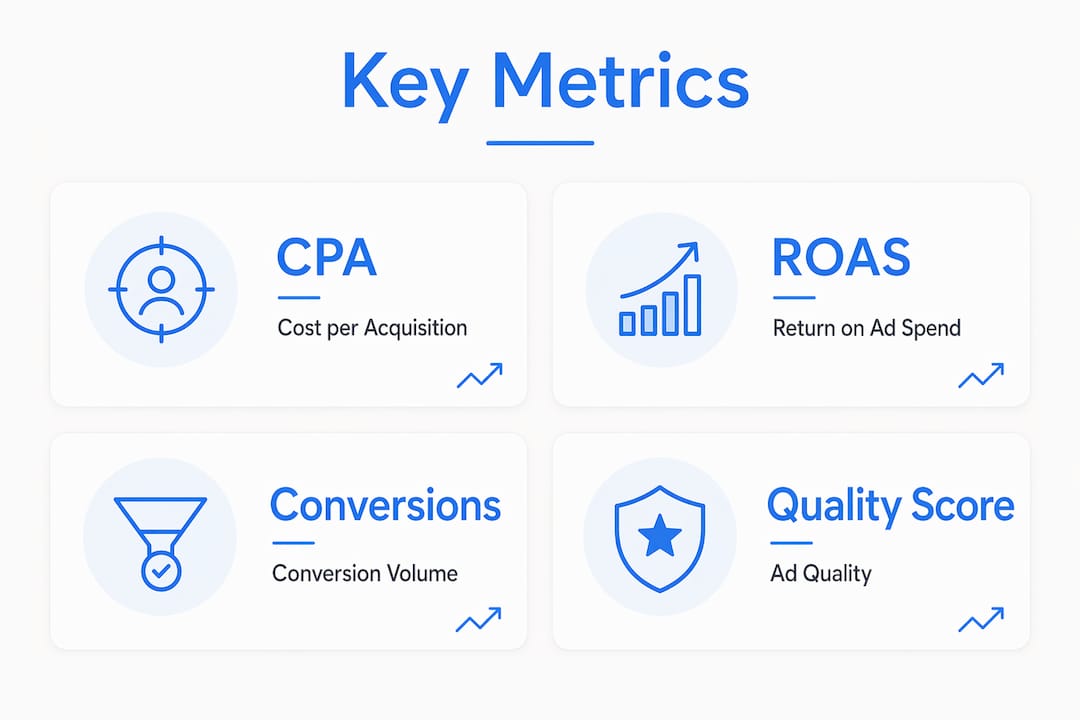
Conversions, Cost Per Acquisition (CPA), and Return on Ad Spend (ROAS) are the three metrics that matter most when you measure Google Ads effectiveness. Every other number in your agency’s report should support or contextualise these three. If your agency leads with impressions and click volume, that is a signal worth noting.
Here is how to interpret the core metrics correctly:
- Conversions: The total number of desired actions completed, whether purchases, form submissions, or phone calls. A rising conversion count with a stable or declining CPA is the clearest sign of improving performance.
- CPA (Cost Per Acquisition): The total spend divided by conversions. Compare this against your customer lifetime value to determine whether the agency is acquiring customers profitably.
- ROAS (Return on Ad Spend): Revenue generated per dollar spent on ads. A ROAS of 4:1 means four dollars returned for every dollar spent. Context matters here because a 4:1 ROAS for a low-margin product may be unprofitable, while a 2:1 ROAS for a high-margin service may be excellent.
- Quality Score: Google’s 1 to 10 rating of your ad relevance, expected click-through rate, and landing page experience. A higher Quality Score reduces your cost per click and improves ad placement. Agencies that ignore Quality Score are leaving money on the table.
- Impression share: The percentage of eligible auctions where your ads appeared. A declining impression share often signals budget constraints or worsening ad relevance.
- CTR (Click-Through Rate) and CPC (Cost Per Click): Supporting metrics that reveal ad copy effectiveness and auction competitiveness. Reports focusing solely on impressions and CTR without linking to revenue do not provide a full picture of agency effectiveness. Revenue and CPA are the metrics that actually tell you whether your agency is earning its fee.
Pro Tip: Ask your agency to present ROAS and CPA figures segmented by campaign type and product category. Blended ROAS across all campaigns can hide underperforming segments that are quietly draining budget.
How to audit data accuracy and conversion tracking to verify agency reporting

Accurate conversion tracking is the foundation of every meaningful performance assessment. Without it, your agency is optimising campaigns based on fiction, and you are making decisions based on the same.
Follow these steps to verify your tracking setup:
- Run a test conversion. Complete a purchase or submit a form on your own website, then check whether the conversion appears in Google Ads within 24 hours. If it does not, your tracking is broken.
- Cross-check with your CRM. Compare the conversion count in Google Ads against the leads or sales recorded in your CRM or database for the same period. A 10 to 15% discrepancy between Google Ads conversion data and internal CRM results is considered normal. Variances above 40% typically signal broken conversion tracking needing immediate audit.
- Use Google Tag Assistant and GA4. Google Tag Assistant identifies misfiring tags, while GA4 provides an independent conversion count. If GA4 and Google Ads diverge significantly, investigate before trusting either source.
- Check for duplicate conversions. Agencies sometimes configure multiple conversion actions tracking the same event, which inflates reported conversion numbers and distorts CPA calculations.
- Review attribution models. Confirm whether your agency uses data-driven attribution or last-click attribution. Data-driven attribution distributes credit across the full customer journey and is generally more accurate for multi-touch campaigns.
Conversion tracking often breaks during site updates or policy shifts. Monthly 30-minute audits to verify test conversions in Google Ads and CRM catch tracking failures before they corrupt weeks of optimisation data.
A critical but often overlooked risk is account ownership. Retaining Google Ads account ownership and conversion tracking setup internally prevents vendor lock-in and allows you to conduct independent audits at any time. If your agency controls the account and the tracking, you have no independent view of your own data.
Pro Tip: Schedule a recurring 30-minute calendar block each month specifically for conversion tracking verification. Treat it the same way you would treat a monthly financial reconciliation.
What strategic and creative factors demonstrate a high-performing Google Ads agency?
Beyond metrics and tracking, the quality of an agency’s strategic thinking separates genuine partners from account managers who press buttons. In 2026, the best agencies earn their fees through first-party data wiring, creative asset quality, and feeding Performance Max campaigns with strong audience signals, not through manual bid adjustments that Smart Bidding now handles automatically.
Assess your agency across these four strategic dimensions:
- First-party data integration: Does your agency use your customer lists, CRM data, and website visitor segments to build Customer Match audiences? Agencies that rely solely on Google’s automated targeting without layering your own data are underutilising one of the most powerful tools available.
- Creative testing cadence: Creative asset quality and frequent refreshes are critical for Performance Max campaigns because creative fatigue is a major cause of plateauing ad performance. Ask your agency how often they introduce new headlines, descriptions, images, and video assets. A strong agency follows a structured A/B testing framework rather than running the same creative for months.
- Automation and Smart Bidding strategy: Evaluate whether your agency uses Target CPA or Target ROAS Smart Bidding with appropriate conversion windows, or whether they are still manually adjusting bids at the keyword level. Manual bid management at scale is a sign of outdated practice. The more relevant question is how well they configure and monitor automated strategies.
- Reporting transparency: Your agency’s reports should link every metric to a business outcome. If the report shows a 15% improvement in CTR but does not explain what that means for revenue or CPA, it is not a useful report.
| Factor | Strong agency | Weak agency |
|---|---|---|
| First-party data use | Customer Match, CRM integration, audience signals | Relies only on Google’s automated targeting |
| Creative management | Regular asset refreshes, structured testing | Same creative running for 3+ months |
| Bidding approach | Smart Bidding with defined CPA or ROAS targets | Manual CPC adjustments without clear rationale |
| Reporting quality | Metrics tied to revenue and business goals | Impressions, clicks, and CTR without context |
Pro Tip: Ask your agency directly: “Show me how you feed audience signals into Performance Max.” Agencies unable to answer in detail are generally low-performing operations that cycle through clients rather than building genuine results.
Watch for these warning signs: locked account access, vague attribution explanations, and ROAS guarantees in proposals. Fixed ROAS promises are unrealistic because market changes, seasonal shifts, and creative fatigue are outside any agency’s control. An agency that promises guaranteed returns is either uninformed or misleading you.
How to structure an ongoing evaluation process for your agency
A one-time audit tells you where things stand today. An ongoing evaluation process tells you whether your agency is improving your results over time. Structure it as follows:
- Define KPIs before the engagement begins. Agree on specific targets for CPA, ROAS, conversion volume, and impression share. Document these in writing so both parties have a shared definition of success.
- Establish baseline metrics. Record your CPA, ROAS, and conversion rate at the start of the engagement. Compare day-one figures against day-30 and day-90 results to measure genuine progress rather than seasonal fluctuation.
- Set up dual reporting sources. Independent GA4 reporting alongside the agency’s dashboard provides two data sources that catch discrepancies early and improve data reliability. Never rely solely on the agency’s own reporting.
- Review competitor intelligence monthly. A thorough evaluation includes auditing how agencies monitor competitors and use intelligence tools to brief strategic campaigns. Ask your agency what competitor ad copy and bidding trends they are tracking and how that intelligence shapes your strategy.
- Assign landing page accountability. Ad performance is directly affected by landing page quality. Clarify whether your agency is responsible for landing page optimisation recommendations or whether that sits with your internal team. Ambiguity here is a common cause of stalled performance.
- Schedule a formal quarterly review. Use the following data table as a template for your quarterly assessment.
| Metric | Baseline (Month 1) | Current (Month 3) | Target |
|---|---|---|---|
| CPA | Record here | Record here | Agreed target |
| ROAS | Record here | Record here | Agreed target |
| Conversion rate | Record here | Record here | Agreed target |
| Quality Score (avg.) | Record here | Record here | 7+ |
| Impression share | Record here | Record here | Agreed target |
Pro Tip: If your agency cannot provide a clear explanation for any metric that has moved more than 20% in either direction, that is a gap in strategic accountability. Strong agencies document the reason behind every significant performance shift.
Key takeaways
Evaluating a Google Ads agency requires verifying data accuracy, assessing strategic sophistication, and measuring outcomes against agreed business targets, not just reviewing activity reports.
| Point | Details |
|---|---|
| Prioritise outcome metrics | Focus on CPA, ROAS, and conversions rather than impressions and CTR. |
| Verify conversion tracking monthly | Cross-check Google Ads data against your CRM and flag variances above 15%. |
| Retain account ownership | Keep Google Ads account access and tracking control internally at all times. |
| Assess creative and data strategy | Strong agencies refresh assets regularly and integrate first-party data into campaigns. |
| Use dual reporting sources | Set up GA4 independently alongside your agency’s dashboard to catch discrepancies early. |
What I have learned from auditing Google Ads agencies
After reviewing dozens of Google Ads accounts across industries, the pattern I see most often is not fraud or incompetence. It is drift. Agencies start strong, then gradually shift to maintenance mode while the client assumes optimisation is still happening. The reports keep arriving, the metrics look stable, and nobody asks the hard questions until the business notices that growth has stalled.
The single most revealing question you can ask an agency is not about ROAS. It is: “Why did you make that specific change last month, and what data informed it?” An agency that cannot answer with specificity is guessing. An agency’s inability to explain why certain creatives or targeting tactics were chosen often indicates guessing rather than data-driven strategy.
I have also seen businesses hand over complete account control and then find themselves unable to access their own conversion history when they eventually change agencies. Retain your account. Retain your tracking. These are non-negotiable.
Creative fatigue is the most underestimated cause of performance plateaus. I have seen accounts where the same Performance Max assets ran for six months without a single refresh, and the agency attributed declining ROAS to market conditions. Fresh creative, tested systematically, is frequently the lever that restores momentum. Pair that with a free Google Ads audit checklist and you have a concrete starting point for any evaluation.
The agencies worth keeping are the ones who bring you problems before you find them yourself.
— Samar
How Beyondclix helps you get more from your Google Ads investment
Beyondclix specialises in Google Ads performance auditing, advanced bidding strategy, and creative optimisation for businesses that want transparent, outcome-linked reporting. If you are unsure whether your current agency is delivering genuine value, Beyondclix’s team conducts thorough tracking audits, builds GA4 dual-reporting setups, and identifies the specific gaps between your ad spend and your revenue. Every client receives a tailored reporting dashboard that connects Google Ads metrics directly to business outcomes, not just platform statistics. To work with a team that treats your budget as carefully as its own, explore Beyondclix’s Google Ads management services and see what a data-driven partnership looks like in practice.
FAQ
What metrics should I use to evaluate my Google Ads agency?
Focus on CPA, ROAS, and conversion volume as primary indicators, supported by Quality Score and impression share. Reports that focus only on impressions and CTR without linking to revenue do not give you a complete picture of agency effectiveness.
How do I know if my conversion tracking is accurate?
Run a test conversion and verify it appears in Google Ads within 24 hours, then cross-check totals against your CRM. A variance above 15% is a reliable indicator of broken tracking that requires immediate investigation.
Should I retain ownership of my Google Ads account?
Yes, always. Retaining account ownership and keeping conversion tracking setup internally prevents vendor lock-in and gives you the ability to conduct independent audits at any time.
What is a red flag in an agency’s proposal?
Fixed ROAS guarantees are a clear warning sign. ROAS guarantees are often unrealistic because market changes, creative fatigue, and seasonal shifts are outside any agency’s control.
How often should I formally review my agency’s performance?
Conduct a monthly conversion tracking audit, a monthly metrics review against agreed KPIs, and a formal quarterly performance assessment comparing current results against your documented baseline.
